


Three out of ten engines run on stolen fuel. How did Neotecnik decide to stop this problem?
Track and digitize sales force operations
Program and manage all fleet maintenance and generate budgets without the need for additional personnel

Discover the top 20 solutions and tools for tracking, security, and end customers

Discover how a virtual copilot in MDT terminals meets safety regulations and optimizes operations

How efficient cold chain control drastically reduces losses and damages to goods?
One of the most critical activities in logistics management is asset control...

Three out of ten engines run on stolen fuel. How did Neotecnik decide to stop this problem?

With the right tools and guidance, migration represents an improvement in the service you provide to your customers and strengthens your position against the competition
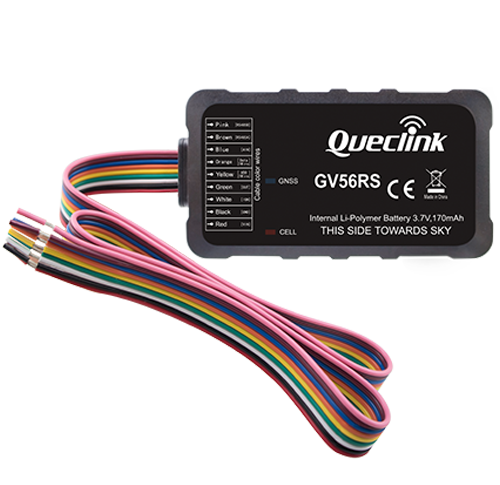
Compact and economical in size, the GV56RS is a model with good performance that uses accessories wired through the RS485 serial port it has. This equipment supports up to ten sensors, including fuel and load, and is designed for trucks with more than one tank containing liquids. The GV56RS is ideal and safe for applications such as UBI-based light vehicle tracking, car rental, stolen vehicle recovery SVR, logistics, and much more. The GV56RS optimizes the available I/O by allowing fuel cut-off, ignition detection, and connection of an analog sensor, as well as driver identification through 1-wire or BLE. Compatible accessories include a range of BLE-based fuel and weight control solutions.

| Manufacturer | Model | Type | I/O | Battery | Communication Methods |
|---|---|---|---|---|---|
| Queclink | GV56RS | GPS | 1/1 | Yes - Internal Battery | GPRS/GSM/TCP/UDP/SMS |
GSM Specifications
|
Frequency |
Quad-band: GSM/GPRS 850 / 900 / 1800 / 1900 MHz Compatible with GSM phase 2/2+ -Class 4 (2W @ 850/900 MHz) -Class 1 (1W @ 1800/1900 MHz) |
|
GPRS |
GPRS multi-slot class 10 GPRS mobile station class B |
|
RMS Phase Error |
5 degrees |
|
Maximum RF Output Power |
GSM850/900: 33.0±2 dBm DCS1800/PCS1900: 30.0±2 dBm |
|
Input Dynamic Range |
-15 ~ -108 dBm |
|
Receiver Sensitivity |
Class II RBER 2% (-107 dBm) |
|
Frequency Stability |
< 2.5 ppm |
GNSS Specifications
|
GNSS Receiver Type |
MTK GNSS Receiver |
|
Sensitivity |
Autonomous: -148 dBm Cold Start: -163 dBm Tracking and Navigation: -165 dBm |
|
Position Accuracy (CEP) |
Autonomous: < 2.5m |
|
TTFF (Clear Sky) |
Cold Start: 32s average Warm Start: 30s average Hot Start: 1s average |
General Specifications
|
Dimensions |
79.5 x 44.3 x 11.9mm 3.13”(L) x 1.74”(W) x 0.47”(H) |
|
Weight |
62g (2.19oz) |
|
Backup Battery |
Lithium Polymer 170 mAh |
|
Operating Time |
Reporting Off: 45 hours 5-Minute Reports: 30 hours 10-Minute Reports: 35 hours |
|
Operating Voltage |
8V to 32V DC |
|
Operating Temperature |
-30°C ~ +80°C -40℃ ~ +80℃ for storage |
|
BLE |
Compatible with BLE 3.0 (two-way voice communication) and BLE 4.0 |
Interfaces
|
Digital Inputs |
One positive digital input for ignition detection or other detection |
|
Digital Outputs |
1 digital output, open-collector/drain, max output current 150 mA |
|
Analog Inputs |
1 input that can be configured as an analog input (0V – 30V) or a negative input |
|
1-Wire Interface |
Supports 1-Wire temperature sensor and iButton driver identifier |
|
Serial Port |
1 RS485 half-duplex serial port |
|
GSM Antenna |
Internal |
|
GNSS Antenna |
Internal |
|
Bluetooth Antenna |
Internal |
|
LED Indicator |
CELL, GNSS |
Communication Protocol
|
Transmission Protocol |
TCP, UDP, SMS |
|
Programmable Reporting |
Reports device status and position based on preset distance parameters, time intervals, mileage, or a combination of these. |
|
Geofences |
Geofence alarm, supports up to 20 circular and 20 polygonal geographic fences |
|
Power-On Report |
Reports when the device powers on |
|
Special Alert |
Special alert based on digital input activation |
|
Remote Activation |
Remote activation of digital outputs |
|
Motion Detection |
Motion alert based on 3-axis accelerometer |
|
Driving Behavior Monitoring |
Detection of aggressive driving behaviors, including harsh braking, rapid acceleration, etc. |
|
Jamming Detection |
Alert based on interference detection |
|
Shock Detection |
Accident data collection for reconstruction and analysis |
|
Tow Alert |
Tow alert activates when the vehicle is off |